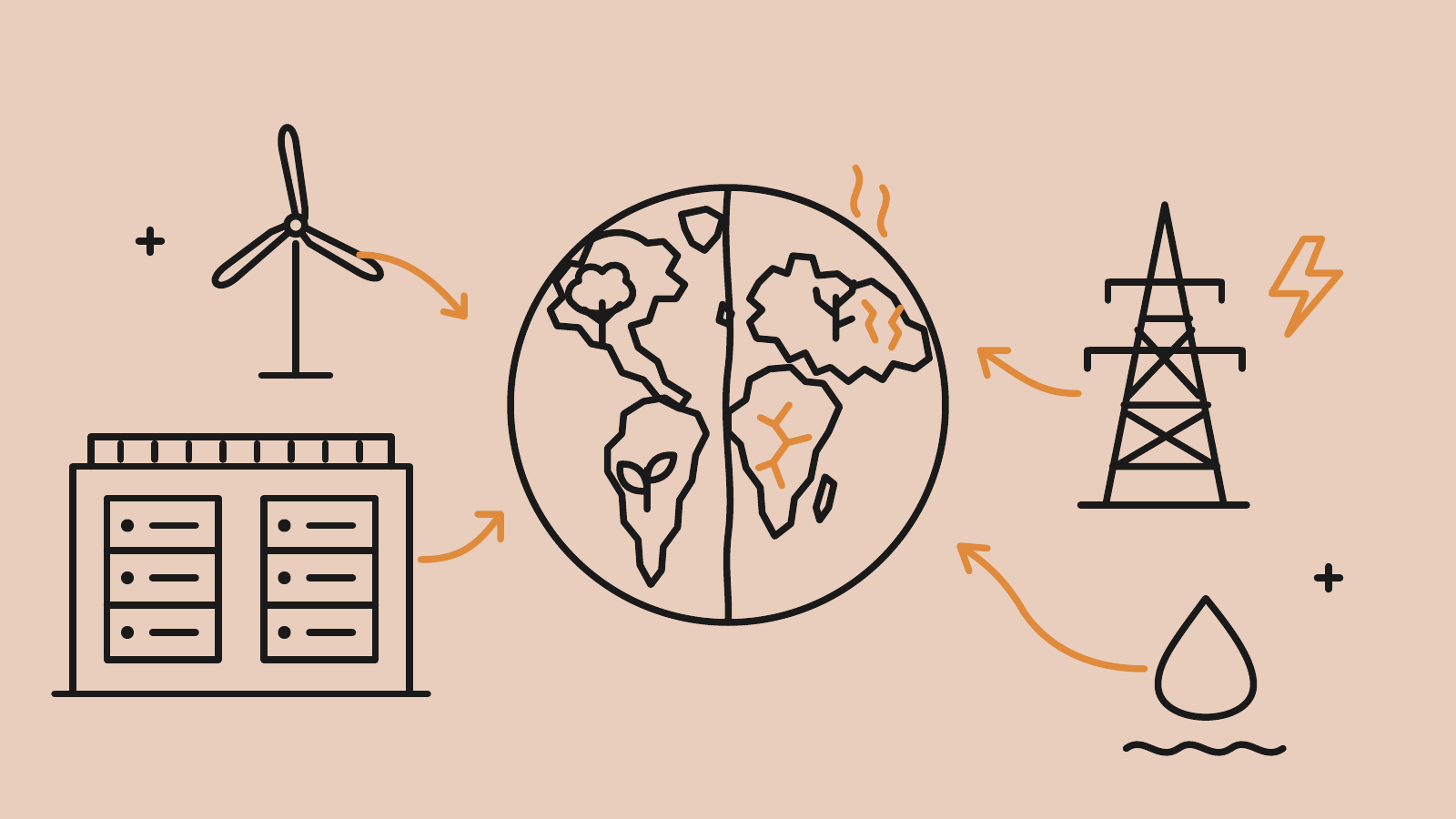
Is AI bad for the planet?
How much electricity and water AI uses, how a prompt compares with Netflix, a kettle or a cup of coffee, and where the real problems sit.
By Rich Tyler · AI for Small Business · 9 min read
In the space of a couple of years, AI has become part of everyday work. It drafts emails, summarises long documents, writes code and answers questions that used to take an afternoon of searching. For a lot of people and small businesses, it’s already giving back hours every week.
Alongside that, there’s a growing worry about what it costs the planet. You’ve probably seen the headlines: data centres draining rivers, every ChatGPT question using a bottle of water, AI wrecking climate targets.
That worry is reasonable. AI runs on electricity, and a lot of it. The buildings it runs in get hot, and cooling them often uses water. If you care about the environment, it’s fair to ask whether you should be using these tools at all.
The difficulty is that the numbers going around vary wildly, and some of the most widely shared ones are well off. So how do you separate what’s true from what’s headline? It helps to look at three things separately: what data centres do to the places they’re built, what your own use adds up to, and where the industry as a whole is heading.
Data centres can be a real problem where they’re built
Data centres are large industrial buildings full of computers that run around the clock. They need a lot of power, and many also use a lot of water to keep the equipment cool. Where they’re built, the effects can be significant.
The UK has around 520 of them, with about 100 more planned. More than three quarters sit in the east and south east of England, which are already the most water-stressed parts of the country (Novara Media, reporting Water UK’s briefing to MPs).
They also need the most water on hot summer days, when outside air is too warm to cool the servers (Water UK). That’s also when hosepipe bans tend to arrive.
The planning hasn’t caught up. The Environment Agency’s forecast of future water needs leaves data centres out completely, and the government’s three main AI growth plans don’t mention water at all. One estimate puts a single hyperscale campus at enough water each day for around 10,000 people (Global Action Plan).
For communities near a proposed site, concerns about water supply and pressure on the local grid are well founded. Where these buildings go, and how they’re cooled and powered, matters a great deal.
Data centres were here long before AI
Data centres have been running the internet for decades. Every email you send, every photo backed up to the cloud, every Netflix series, Spotify playlist, online banking login and hour spent scrolling on your phone passes through one.
Global data centre electricity use was already growing by about 12% a year from 2017, five years before ChatGPT launched in November 2022 (IEA).
In 2024, servers built for AI used about 15% of all data centre electricity (Scientific American, reporting the IEA). The other 85% was mostly the everyday internet.
AI is now the fastest-growing part. In 2025, electricity use at AI-focused data centres rose 50%, against 17% for data centres overall (Enlit, reporting the IEA). AI will need a lot more of these buildings. The questions about where they go and how they’re run were already there, and AI makes them more urgent.
For scale, data centres used about 1.5% of the world’s electricity in 2024. The IEA expects them to account for around a tenth of the growth in electricity demand to 2030, less than air conditioning, electric cars or industrial motors (IEA).
Smarter ways to build them
Cooling and power are the industry’s biggest problems, and some of the most interesting engineering work is happening there.
Off the coast of Shanghai, a data centre now sits on the seabed about 10 km offshore. It’s powered directly by a neighbouring offshore wind farm and cooled by seawater. Its developers say the design cuts electricity use by 22.8% and uses no fresh water at all (RenewEconomy). Microsoft tested a similar idea off Orkney from 2018 and found its underwater servers failed less often than those on land, though it closed the project in 2024 (Anadolu Agency).
Near Stavanger in Norway, Green Mountain runs a data centre inside a former NATO ammunition store cut into the rock. It’s cooled with 8°C water drawn from the fjord next door all year round, and powered by hydroelectricity (Schneider Electric).
In Finland, Microsoft and the energy company Fortum are building data centres near Helsinki designed so their waste heat feeds the local district heating network. Once running, the heat is expected to cover about 40% of heating needs for around 250,000 users in Espoo and neighbouring towns, replacing coal and cutting about 400,000 tonnes of CO2 a year (Fortum). In Denmark, heat from Meta’s data centre warms about 6,900 homes (The Fifth Estate).
There’s a smaller version in Devon. A UK company called Deep Green installed a compact data centre at Exmouth Leisure Centre, and the heat from its servers warms the 25-metre pool for free. It was expected to cut the pool’s gas use by about 62%, with similar installations planned for Bristol and Manchester (Data Centre Review).
None of these is the norm yet. They do show that a data centre can be designed to give something back to the place it’s built.
How your own use compares: electricity
The most useful test is to compare a prompt with things most of us do every day without a second thought.
In 2025 Google published the first detailed per-prompt figures from a major AI company. Its median Gemini text prompt used 0.24 watt-hours of electricity (Google). OpenAI has put an average ChatGPT prompt at 0.34 watt-hours (Bernama).
| Everyday activity | Electricity used |
|---|---|
| A typical week of AI use (20 prompts a day) | about 34 to 48 Wh |
| 1 hour of Netflix | about 77 Wh |
| Boiling 1 litre in the kettle | about 110 Wh |
Sources: Google, IEA on streaming, Vodzilla on the kettle. The weekly figure is my own maths: 140 prompts at 0.24 to 0.34 Wh each.
A full week of everyday AI use comes to less than an hour of Netflix, and less than half of one kettle.
Streaming went through a similar scare. In 2019 a widely shared estimate claimed half an hour of Netflix had the same footprint as driving 4 miles. When the IEA checked the maths, the original figure turned out to be about 80 times too high (IEA). Netflix’s own footprint research since then, a project called DIMPACT, was led by the University of Bristol.
How your own use compares: water
Water is where the headlines get loudest, so it helps to set a prompt alongside the food and drink we buy every day.
The figures below are water footprints. For food, that’s all the water used to produce it: mostly rain and irrigation on the farm, plus processing. For an AI prompt, it’s the water used to cool the data centre while it answers you.
| Item | Water used to produce it | Equivalent in AI prompts |
|---|---|---|
| 1 median Gemini text prompt | 0.26 ml | 1 |
| 1 avocado (global average) | about 70 litres | about 270,000 |
| 1 cup of coffee | about 140 litres | about 540,000 |
| 1 avocado grown in Petorca, Chile | about 320 litres | about 1.2 million |
| 1 hamburger | about 2,400 litres | about 9 million |
Sources: Google, Danwatch on avocados, Water Footprint Network figures via Scientific American. The prompt column is my own maths.
A cup of coffee is equivalent to about half a million prompts. A hamburger is about 9 million. Someone using AI 20 times a day for a whole year would account for under 2 litres of cooling water, while one cup of coffee took around 140 litres to produce.
These aren’t perfect like-for-like comparisons. Google’s figure covers water used at its own data centres, not at the power stations that supply them. Even if the true AI figure were 10 times higher, a year of prompts would still use far less water than a single cup of coffee.
The avocado also shows why location matters. Petorca grows over 60% of Chile’s avocados, and in that dry region each one takes more than 4 times the global average. Data centres follow the same pattern: the same building can be harmless in one place and a real strain in another.
Where AI does get heavy: video and images
Everything so far covers text. Generating video is a different matter.
MIT Technology Review estimated that a 5-second clip from one leading video model used about 3.4 million joules, roughly 0.94 kWh (via Hardware Busters). That’s about the same as running a microwave for over an hour.
Against the table above, one 5-second clip is roughly 12 hours of Netflix, or nearly 4,000 text prompts. It also often takes several attempts to get a clip worth keeping.
Image generation sits between text and video, and varies a lot by model. One study found it used more than 30 times the energy of generating text (Luccioni et al., summarised by Lenz).
For anyone wanting to reduce their own AI footprint, video is the place to start. A single short clip uses about the same electricity as 4 to 6 months of asking 20 questions a day.
AI is also helping cut emissions
The same technology is being used to tackle environmental problems directly.
Contrails, the white lines planes leave in the sky, cause roughly 35% of aviation’s warming effect. Google Research, American Airlines and Breakthrough Energy used AI to predict where planes would form them. Over 70 test flights, pilots who followed the predictions cut contrails by 54% (Energy Monitor).
In the UK, Open Climate Fix, a non-profit co-founded by a former DeepMind researcher, has worked with the national grid operator on AI forecasts of solar power. More accurate forecasts mean fewer fossil-fuel generators kept running on standby in case the sun goes in (NESO).
In industry, the IEA estimates AI could cut energy costs by 3% to 10%, though take-up is being held back by gaps in digital skills and data (Petromindo, reporting the IEA). Used widely across industrial processes, it could save as much energy each year as Mexico uses (Data Centre Magazine, reporting the IEA).
Whether AI ends up helping or harming the environment overall depends a great deal on what we use it for.
So, is AI bad for the planet?
For everyday text use, the impact is small. A week of typical use takes less electricity than an hour of Netflix, and a year of it uses less water than a single cup of coffee.
The bigger picture is more serious. Microsoft’s emissions rose 25% in a year, Google’s 18% and Amazon’s 16%, with all three pointing to the AI build-out (ESG Dive, AFP via Macau Business). Microsoft’s own report says sustainability solutions aren’t scaling fast enough to keep up. And for communities near new data centres, the pressure on water and the grid is real.
Most of that comes down to where data centres are built, how they’re cooled and what powers them. Those are planning and policy decisions, and they’re where public pressure makes the biggest difference.
Using AI responsibly
A few habits go a long way:
- Use AI for text freely, and think twice before generating lots of video or images you don’t need.
- Where you have a choice, favour providers that publish their energy and water figures and run on renewable power.
- Keep an eye on planning applications for data centres in your area, and ask how they’ll be cooled and powered.
If you want to go further, you can offset. For carbon, Google puts a median prompt at 0.03 g of CO2, so a year of 20 prompts a day comes to around 220 g. Offsetting that costs pennies. Quality varies a lot between schemes, so it’s worth choosing one certified to a recognised standard.
Water offsetting exists too, though it’s newer and mostly aimed at businesses. In the US, Water Restoration Certificates pay water-rights holders to leave water in rivers and streams, with each certificate representing 1,000 gallons restored (CSR Wire). In the UK and Spain, Act4Water sells credits that fund verified water restoration projects (Green Finance Institute). Some of the big providers do this at scale: Microsoft says it replenished more water than it used in its 2025 financial year (ESG Dive).
For individuals in the UK, supporting your local rivers trust is the closest equivalent, and it does the most good when the restoration happens in an area that’s under pressure.
AI is a useful tool with a real, manageable footprint. Knowing where that footprint sits, and using the tools with a bit of thought, is a sensible place to start.
Want a hand with your own?
Free 30 minute call. Tell me what's on your mind and I'll tell you honestly what's worth doing about it.
Book a 30 minute call →